
Knowledge Base / Restructuring
Restructuring in Poland: types of proceedings and key stages
Compare four Polish restructuring procedures: PZU, accelerated arrangement, arrangement and sanation. Learn the main stages and what investors should check.
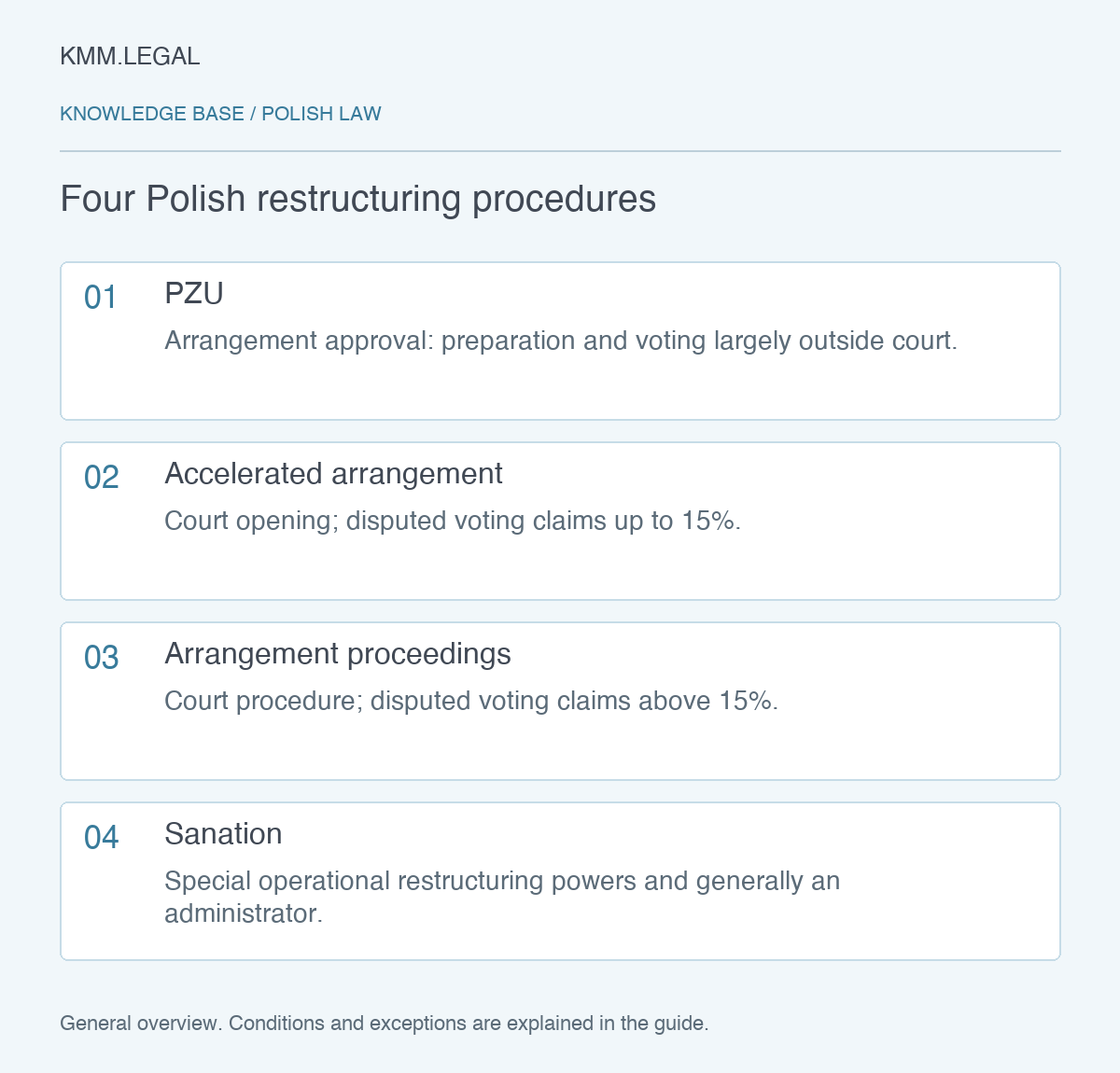
Poland has four restructuring procedures: arrangement approval proceedings (PZU), accelerated arrangement proceedings, arrangement proceedings and sanation proceedings. Each can lead to a binding arrangement with creditors, but they differ in court involvement, management control, treatment of disputed claims and the tools available to repair the business.
For foreign investors, lenders and directors of Polish subsidiaries, the first question is whether the business mainly needs revised debt terms or a deeper operational turnaround. A Polish procedure should be selected after checking eligibility, creditor claims, security and the funding needed to continue trading.
Who can use restructuring proceedings in Poland?
The Restructuring Law applies to eligible debtors who are insolvent or threatened with insolvency. It covers entrepreneurs and specified other entities, subject to exclusions and special rules. A bank, insurer or other excluded financial institution should not be assumed to follow the ordinary corporate framework.
Restructuring is intended to avoid bankruptcy while protecting creditors’ legitimate interests. The court must refuse to open proceedings if their effect would prejudice creditors. Arrangement and sanation proceedings also require the debtor to demonstrate a credible ability to pay proceeding costs and obligations arising after opening (Articles 4, 6 and 8).
The 15% disputed-claims threshold described below concerns claims carrying voting rights. It is not a percentage of every liability in the accounts.
Types of restructuring proceedings: a comparison
| Procedure | Disputed voting claims | General management model | Key feature |
|---|---|---|---|
| Arrangement approval proceedings (PZU) | No more than 15% | Debtor with a contracted arrangement supervisor; additional controls following a KRZ notice | Preparation and voting largely outside court; judicial approval follows |
| Accelerated arrangement proceedings | No more than 15% | Generally debtor under a court supervisor | Court opening and a simplified creditor-list procedure |
| Arrangement proceedings | More than 15% | Generally debtor under a court supervisor | A fuller procedure for establishing creditor claims |
| Sanation proceedings | No equivalent 15% ceiling | Generally a court-appointed administrator | An arrangement combined with special operational restructuring powers |
These are starting points, not a substitute for checking exceptions. In particular, management powers can be restricted or removed in court-supervised procedures, while the court may exceptionally allow limited debtor management in sanation.
1. Arrangement approval proceedings — PZU
In postępowanie o zatwierdzenie układu, the debtor contracts with an arrangement supervisor who meets the statutory requirements. The debtor prepares for an arrangement, determines an arrangement date and obtains creditor votes through the statutory process. The court is then asked to approve the adopted arrangement. There is no equivalent initial court order opening PZU.
A notice fixing the arrangement date can be published in the National Register of Debtors (KRZ) if the conditions are met. This activates statutory protection and additional supervision over management. Signing a supervisor agreement alone does not activate the same protection. Transactions beyond ordinary management require the relevant consent during the notice-protection period.
PZU is a procedure to consider where the core business can continue and the central challenge is agreeing revised repayment terms. It does not give the supervisor the full operational powers of a sanation administrator.
Read our detailed guide to PZU, its protections and deadlines. Separate four-month rules concern the arrangement date, validity of votes and the effects of the notice; they should not be confused with a guaranteed completion time. Statutory preparation and creditor-information requirements also affect the timetable.
2. Accelerated arrangement proceedings
Przyspieszone postępowanie układowe requires a court opening order. It is available where disputed claims carrying voting rights do not exceed 15% of all claims carrying voting rights. A court supervisor oversees the process, and the debtor generally continues ordinary management, subject to the applicable controls.
The creditor list is prepared and approved in a simplified procedure. The process then moves towards creditor voting and court approval. The word “accelerated” describes the statutory structure; it does not guarantee a particular number of weeks in every case.
This option may be relevant where a judicial framework is appropriate, the amount of disputed voting claims is limited and full sanation powers are unnecessary. Check the applicable protection and claim-verification rules rather than treating it as PZU with a different label.
3. Arrangement proceedings
Postępowanie układowe is the court procedure for a debtor whose disputed claims carrying voting rights exceed the 15% threshold. Compared with the accelerated procedure, the creditor-list process allows more extensive examination of claims and objections.
The debtor generally manages the business under a court supervisor. Preparing and resolving disputes about claims can affect the voting timetable. As with other procedures, the business needs credible arrangement proposals and a plan explaining how it will operate and fund repayments.
A large disputed-claim balance does not, by itself, mean sanation is needed. The separate question is whether special operational restructuring measures justify the greater intervention of sanation.
4. Sanation proceedings — operational restructuring
Postępowanie sanacyjne combines an arrangement with measures intended to restore the debtor’s ability to meet its obligations. On opening, the court generally removes the debtor’s own management and appoints an administrator (zarządca). Exceptionally, Article 288(3) permits the debtor to retain ordinary management of all or part of the enterprise on statutory conditions.
Sanation is commercially most relevant to larger or more complex businesses requiring a substantial turnaround. It is not legally reserved for large companies. Its suitability depends on what needs to change, the expected creditor outcome and the ability to fund the process.
- Employment: Article 300 gives opening effects corresponding to employer bankruptcy in the employment sphere. This does not eliminate employee entitlements or all procedural duties.
- Contracts: the administrator may withdraw from qualifying unperformed reciprocal contracts under Article 298 with the judge-commissioner’s consent, subject to statutory conditions and exceptions.
- Asset sales: a special sale under Article 323 requires the relevant consent and has effects corresponding to a trustee’s bankruptcy sale. Ordinary-course disposals do not automatically receive those effects.
Sanation should be budgeted as a substantial project. A planning horizon of around a year or longer may be appropriate; it is neither a statutory minimum nor an official average. Article 321 addresses convening a creditors’ meeting within 12 months of opening, with specified exceptions. Court approval, finality and performance of the arrangement are separate stages.
How do Polish restructuring proceedings work?
- Assess the business and select the procedure. Review insolvency, disputed claims, security, enforcement, operational problems and funding.
- Prepare documents and engage the appropriate professional. The appointment mechanism differs: the debtor contracts with a PZU supervisor; the court appoints the supervisor or administrator in the judicial procedures.
- Activate the relevant procedure. This may involve a PZU notice or a court opening order. The date and legal basis determine the protection available.
- Establish creditor claims and develop the plan. Prepare the restructuring plan, arrangement proposals and any required feasibility and creditor-comparison materials. Resolve claims under the procedure’s rules.
- Negotiate and vote. The general Article 119 rule combines a majority in number of voting creditors who cast valid votes with at least two thirds in claim value held by voting creditors. Group voting, exclusions and possible approval despite opposition by some groups require separate analysis.
- Obtain court approval and perform the arrangement. An adopted arrangement remains subject to court scrutiny. Completion of proceedings is distinct from payment of instalments over the following years.
What should overseas investors and Polish company directors check?
- Authority: who can sign financing, security or sale documents and which consents are required?
- Claim treatment: is the claim covered, secured, disputed or affected by voting exclusions?
- Funding: can the company pay new obligations, costs and the planned investment?
- Acquisition structure: a sale by a debtor in restructuring is not automatically equivalent to a bankruptcy asset sale.
- Directors’ duties: restructuring preparations or a PZU notice do not automatically satisfy the statutory liability defences.
- Timetable and information: check the KRZ record, court orders, applicable law and the documents supporting the commercial plan.
For transaction planning, see buying a business in Poland and acquiring assets from a bankruptcy trustee. Directors should separately consider Article 299 liability and Article 116 tax liability.
Discuss a Polish restructuring with KMM.LEGAL
We help assess available procedures, review documents, prepare legal steps and represent clients within an agreed engagement. Explore our restructuring and insolvency services or contact our team.
Our affiliated company BM Restrukturyzacje also acts in statutory restructuring roles. Legal representation and the independent responsibilities of a supervisor or administrator must be kept distinct; a court appointment is required where the law provides for it.
Legal sources and scope
Checked on 15 October 2026. This guide explains the ordinary Polish corporate restructuring framework. The Polish legislation is authoritative. Special debtor regimes and proceedings governed by transitional provisions require separate assessment.
- Restructuring Law: in particular Articles 2–8, 35–39, 51, 119, 165, 210–220, 226a–226g, 227–280 and 283–324.