
Knowledge Base / Restructuring
Restructuring in Poland: arrangement approval proceedings (PZU)
Understand Polish arrangement approval proceedings (PZU): eligibility, creditor voting, protection, deadlines and what investors should check.

Polish arrangement approval proceedings, known as postępowanie o zatwierdzenie układu or PZU, allow a business to agree revised repayment terms with its creditors. Preparation and voting take place largely outside court with an arrangement supervisor. The court then decides whether to approve the adopted arrangement.
For an investor, PZU may provide a framework for funding a turnaround. It does not itself transfer the business to an investor, guarantee debt reduction or resolve every liability of the management board.
Which businesses can use PZU?
Restructuring is available to an insolvent debtor or a debtor threatened with insolvency, within the statutory eligibility rules and exclusions. PZU is available where disputed claims carrying voting rights do not exceed 15% of the total claims carrying voting rights. This is not simply 15% of all balance-sheet liabilities.
The business needs a credible operating and financing plan. Identify how current expenses, new obligations and arrangement instalments will be paid. A hoped-for investment should be distinguished from committed funding.
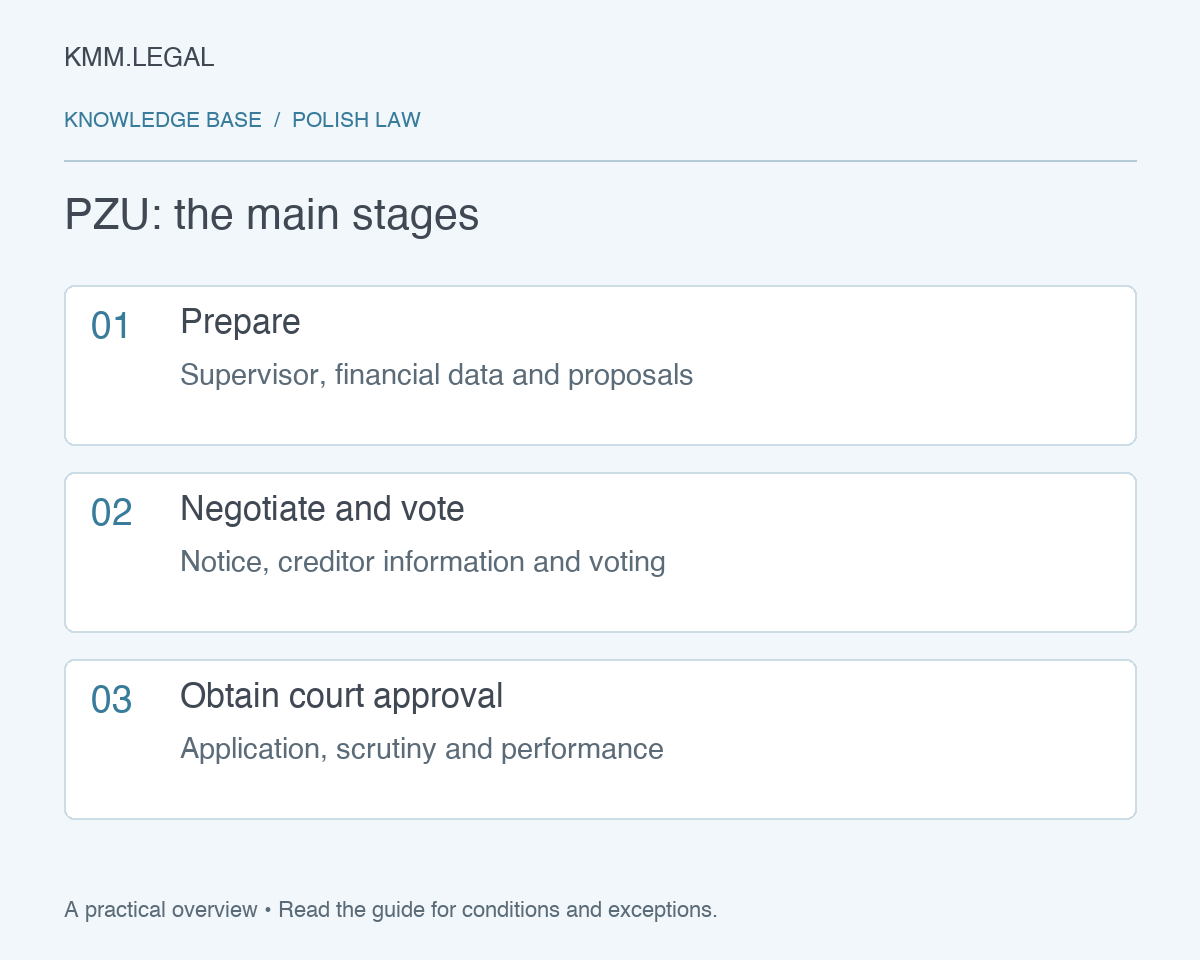
How do the proceedings work?
- Appoint a supervisor. The debtor contracts with a person meeting the statutory requirements. This differs from a court-appointed supervisor in other restructuring procedures.
- Set the arrangement date and prepare documents. The arrangement date determines creditors’ rights and the arrangement’s effects. Claims arising afterwards are not covered. The restructuring plan explains operational measures and funding; arrangement proposals set out the proposed treatment of claims.
- Consider a notice in KRZ. After the required preliminary documents have been prepared, the supervisor may publish the notice fixing the arrangement date in the National Register of Debtors (KRZ), subject to eligibility restrictions.
- Obtain votes. Creditors vote through the statutory process, generally using KRZ. The supervisor checks the votes and whether the arrangement has been adopted.
- Apply for court approval. The debtor files the application and supporting documents. The court reviews legality and the statutory grounds for refusal. The approved arrangement is then performed on its terms.
Article 211b requires specified documents to be prepared at least 30 days before collection of votes begins or the creditors’ meeting is convened. They include the restructuring plan and an opinion on feasibility. The satisfaction test compares the arrangement outcome with alternatives; Article 10a(4) provides an exception for micro-enterprises. The timetable must also account for applicable creditor-information requirements.
Voting does not require every creditor’s consent
The general rule in Article 119 combines a majority in number of voting creditors who cast valid votes with at least two thirds of the value of claims held by voting creditors. Group voting has additional rules. In specified circumstances, an arrangement can be adopted despite opposition from certain groups, but the statutory safeguards must be met.
For a creditor or investor acquiring claims, eligibility, security, disputed amounts and connected-party restrictions matter. Do not calculate the result from a simple list of all debts or assume that acquiring a claim automatically delivers a decisive vote.
What protection does the KRZ notice provide?
The notice triggers statutory protection concerning enforcement and specified contracts. Its scope depends on the obligation, security and relevant provisions. Merely signing a contract with a supervisor does not produce the same protection.
Management powers also change: the supervisor exercises specified powers of a court supervisor, and transactions beyond ordinary management require the relevant consent. The court can lift the effects of the notice in the circumstances set out in the Act, including creditor prejudice.
An investor should check whether the proposed financing, security or asset disposal requires consent and whether it is consistent with the restructuring plan. PZU does not mean that an ordinary sale by the debtor has the same debt-clearing effects as a sale by a bankruptcy trustee.
Three separate four-month rules
- Arrangement date: under Article 211, it must fall no earlier than four months and no later than the day before the approval application; if a notice is published, it must also be no later than that notice.
- Validity of a vote: Article 215 requires the application to reach the court before four months have elapsed from the vote.
- Effects of the notice: under Article 226g, these expire by law if no approval application is filed within four months of the notice.
These are not a promise that the entire case will finish in four months. Document preparation and court review add time. Older proceedings may follow earlier rules under the transitional provisions of the amendment of 25 July 2025.
What should investors and directors prepare?
Collect creditor and security schedules, disputes and enforcement records, current financial information, cash-flow forecasts, key contracts, employment data and details of earlier restructurings. Make clear which investment commitments are binding and which conditions remain outstanding.
Directors must separately monitor bankruptcy-filing duties. A notice in KRZ does not replace the timely court decision required by the restructuring limb of the defences under Article 299 or Article 116.
KMM.LEGAL provides legal advice and representation. Our affiliated company BM Restrukturyzacje acts in statutory restructuring roles; the engagement and responsibilities must reflect those distinct functions.
Discuss your plans with KMM.LEGAL
We review the documents, explain the Polish legal framework and agree the scope of advice or representation in English.
Legal sources and scope
Checked on 14 October 2026. This guide explains Polish law in English; the linked Polish legislation is authoritative. Earlier proceedings may be subject to transitional provisions. The application of these rules depends on the facts and documents of each matter.