
Knowledge Base / Business acquisitions
Buying a business or assets from a bankruptcy trustee in Poland
Buying assets from a Polish bankruptcy trustee: tender rules, debts, mortgages, due diligence, pre-pack and practical risks for investors.

A purchase from a Polish bankruptcy trustee can give an investor access to an operating enterprise, real estate, machinery or other assets. Bankruptcy sales have special legal effects, including important protections against the bankrupt seller’s liabilities. These protections do not remove every burden or operational risk.
This guide concerns an ordinary corporate bankruptcy. Special regimes, including banking, developer insolvency and simplified consumer bankruptcy, require separate analysis.
What does the trustee sell?
The trustee, known in Polish as syndyk, realises assets belonging to the bankruptcy estate. Under Article 160 of the Bankruptcy Law, the trustee acts in their own name but for the account of the bankrupt debtor. The trustee is not personally the owner of the business being sold.
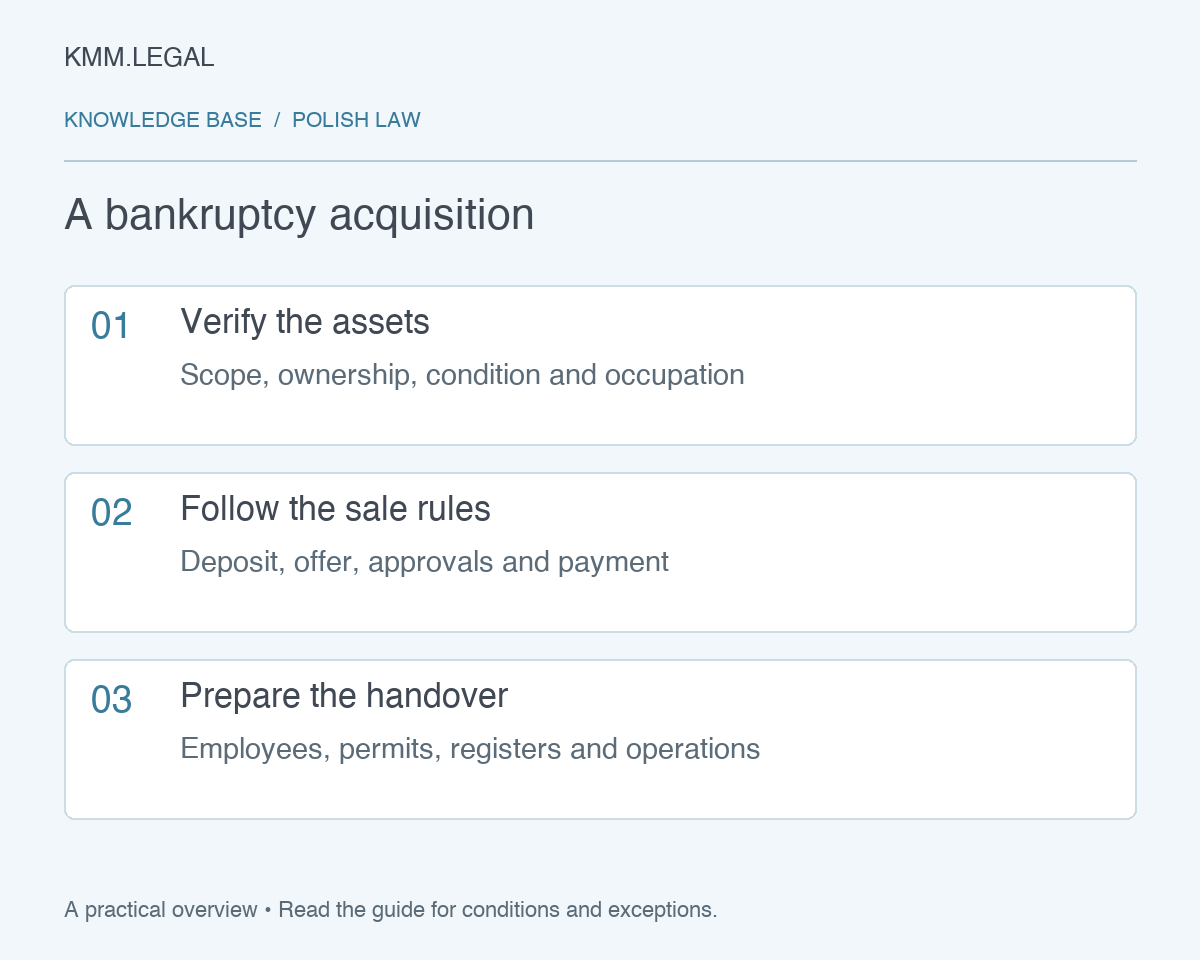
The statutory starting point is the sale of the enterprise as a whole under Article 316. Where that is not possible, Article 318 permits a sale of an organised part. Individual assets can also be sold. Identify the precise inventory and exclusions: acquiring an enterprise is different from acquiring shares in the bankrupt company.
Tender, auction or negotiated sale?
For the procedure in Article 320, the judge-commissioner approves the tender or auction conditions and the trustee conducts the process under judicial supervision. Selection of the bidder also requires approval. The highest bid alone does not transfer ownership.
A negotiated sale may be possible. The consent rules in Articles 206 and 213, and any applicable exceptions, must be checked. A trustee may use a competitive offer process even for a negotiated sale; the label in an advertisement does not determine the legal procedure.
Read the full sale conditions: deposit, price and taxes, submission deadline, required signatures and documents, offer validity, payment arrangements and circumstances in which the deposit may be retained. Do not assume missing documents can be supplied later or that an ordinary email is a valid bid.
Do debts and mortgages pass to the buyer?
Article 313 gives a bankruptcy sale the effects of an enforcement sale and excludes the purchaser’s liability for the bankrupt debtor’s tax obligations, including those arising after the bankruptcy declaration. Under Article 317(2), the purchaser of the enterprise is not liable for the bankrupt debtor’s obligations and acquires it free of encumbrances, subject to the exceptions in Article 313(3)–(4).
A mortgage generally expires on the sale of the property; the sale agreement is the basis for its deletion from the land and mortgage register. Expiry and removal of the register entry are separate steps. Certain rights remain, including necessary-access and transmission easements. Usufruct, lifetime rights and other easements need individual assessment under the statutory exceptions.
The buyer must still pay its own purchase price, taxes and transaction costs. The protection does not settle every question about employees, leases, permits or continued operations.
Employees, tenants and business continuity
Buying property does not automatically provide vacant possession. Article 108 refers to the effects of an enforcement sale on leases and tenancies. Inspect the contracts, occupation and realistic handover date.
Article 317(2a) applies the workplace-transfer provisions of Article 23¹ of the Labour Code accordingly. Employment issues therefore remain part of due diligence. Article 317(1) provides for transfer of concessions, permits, licences and reliefs on acquisition of the enterprise unless separate legislation provides otherwise. Do not extend that rule automatically to an isolated asset purchase.
Check pending proceedings as well: Article 317(3) addresses substitution of the purchaser in specified proceedings concerning the enterprise or its components. For foreign buyers, property permits and other acquisition requirements must be reviewed independently of the bankruptcy sale.
What to check before submitting an offer
- Verify the bankruptcy proceedings, the trustee’s appointment and the sale documents.
- Inspect ownership, encumbrances, third-party claims, asset condition and access to premises.
- Identify licences, contracts, staff, IT access and intellectual property needed to operate.
- Arrange funding in time for the deposit and the balance, including taxes and restart costs.
- Read the draft contract and identify required approvals, signatures and handover obligations.
Do not assume warranty protection is the same as in an ordinary negotiated sale. Your inspection and the sale’s legal effects matter. An estate valuation is not a substitute for your own investment appraisal.
Completion and the pre-pack alternative
In the Article 321 procedure, the trustee signs the contract within the period fixed by the judge-commissioner, no longer than four months after approval of the bidder. That is not a universal deadline for every trustee sale. Failure attributable to the bidder can have deposit consequences and excludes that bidder from the next tender or auction under Article 321(2).
Pre-pack, or przygotowana likwidacja, is a separate route under Articles 56a–56h. Sale terms for an enterprise, an organised part or assets representing a significant part of the enterprise can be proposed during the proceedings for declaration of bankruptcy. The application identifies the price and buyer and includes a description and valuation prepared by a person on the court experts’ list. Article 56a(2a) requires a deposit equal to one tenth of the offered price.
Pre-pack requires court approval; a private agreement with a distressed owner is not enough. Article 56e(3) applies the sale effects in Articles 313, 314 and 317. Compare this route with an ordinary business acquisition before committing funds.
Discuss your plans with KMM.LEGAL
We review the documents, explain the Polish legal framework and agree the scope of advice or representation in English.
Legal sources and scope
Checked on 14 October 2026. This guide explains Polish law in English; the linked Polish legislation is authoritative. Earlier proceedings may be subject to transitional provisions. The application of these rules depends on the facts and documents of each matter.