
Knowledge Base / Directors’ liability
Directors’ liability for Polish tax arrears: Article 116
Article 116 of the Polish Tax Ordinance: management board liability for company tax arrears, statutory defences, evidence and appeals.
Management board members can become personally liable for a Polish company’s tax arrears. Article 116 of the Tax Ordinance requires specific conditions, including ineffective enforcement against company assets and a connection with the member’s relevant period in office. It also provides grounds for avoiding liability.
The tax authority determines this liability by an administrative decision. This differs from the civil proceedings concerning company debts under Article 299 of the Commercial Companies Code.
Which companies and periods are covered?
Article 116 covers limited liability companies, simple joint-stock companies and joint-stock companies, including those in formation. It contains additional rules for companies in formation without a management board and the relevant board-of-directors structure.
Former board members may also be liable. As a general rule, Article 116(2) connects liability to obligations whose payment deadlines fell during the period when the person performed management-board duties. Specific rules apply to amounts under Articles 52 and 52a and to the situation after liquidation under Article 116(2a).
Match appointment and departure documents with each tax payment deadline. The date of a later assessment decision should not simply be treated as the payment deadline for every underlying obligation. Social-security contribution liability arises through separate statutory provisions and needs its own analysis.
What must the tax authority establish?
The authority examines the existence and amount of the arrears, the relevant period of board duties and whether enforcement against the company was wholly or partly ineffective. It must consider the evidence concerning the member’s statutory defences.
Liability is joint and several and can extend to the member’s entire assets. Article 107 also determines the treatment of specified interest and enforcement costs. Check the calculation rather than assuming exposure is limited to the principal tax.
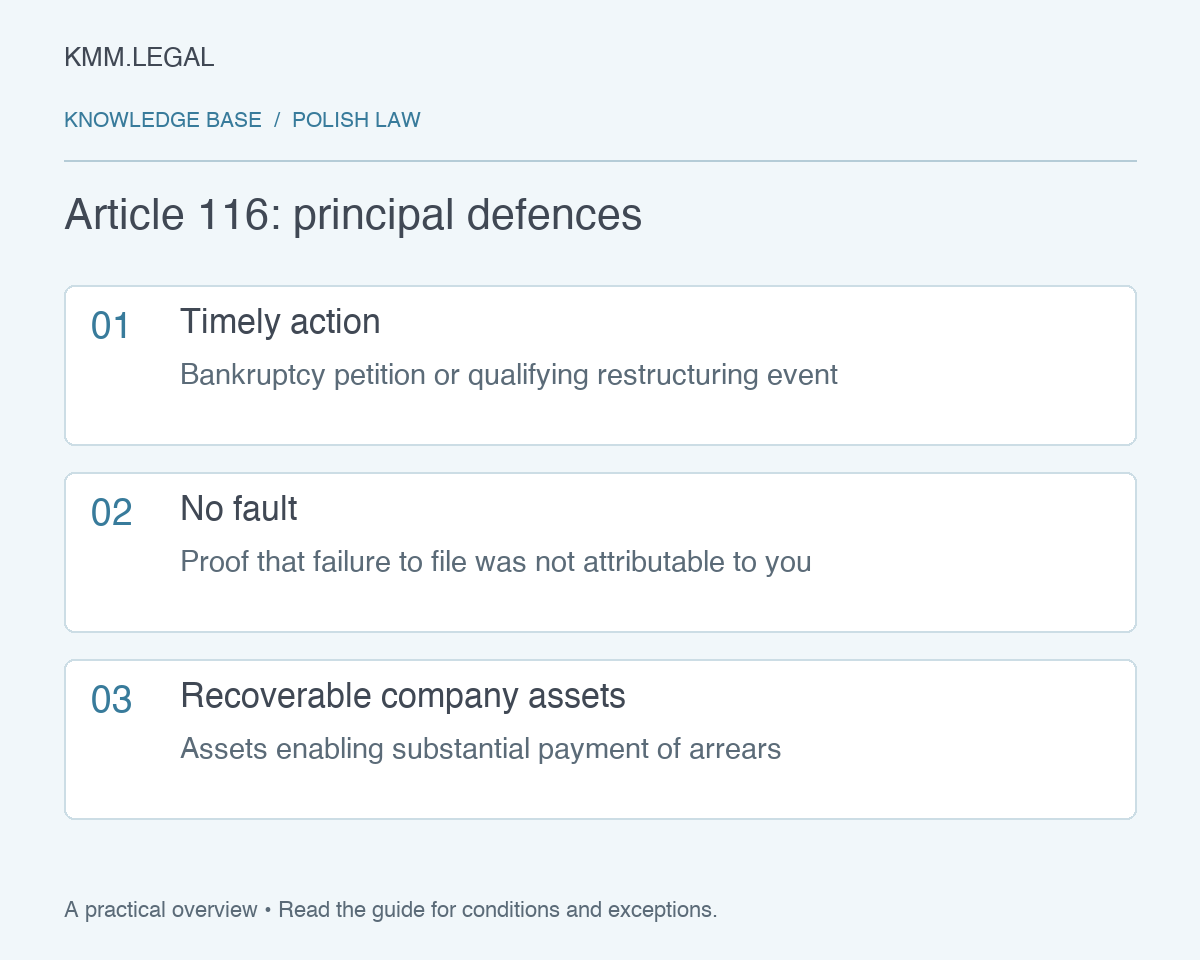
Timely bankruptcy or restructuring action
A board member may demonstrate that a bankruptcy petition was filed at the proper time, or that restructuring proceedings were opened or an arrangement was approved in arrangement approval proceedings within that time.
A supervisor’s appointment, a KRZ notice or the mere filing of a restructuring application does not replace the event required by Article 116(1). Insolvency must be analysed under Article 11 of the Bankruptcy Law together with the filing duty under Article 21. The general 30-day filing period runs from the grounds for bankruptcy, not from receipt of a tax-authority letter.
No fault in failing to file
Another defence is showing that the bankruptcy petition was not filed without fault on the board member’s part. Explain the specific obstacle and provide the documents demonstrating its significance.
Delegating finance to a colleague or an external accountant does not itself establish the defence. The assessment concerns available information, steps taken and the actual ability to discharge the duty. Article 116(1a) separately addresses a filing duty that arose and existed exclusively during enforcement by compulsory administration or sale of the enterprise.
Identifying assets that allow substantial recovery
A board member can also identify company assets against which enforcement would enable payment of a substantial part of the arrears. Identify an actual asset, establish that it belongs to the company and explain why recovery is realistic.
For a receivable, that includes its enforceability and the debtor’s ability to pay. For property, check ownership and burdens that affect recoverable value. An old balance-sheet figure alone does not establish an available source of repayment. Article 116 does not set a universal percentage defining a substantial part.
No creditor loss is not a separate Article 116 defence. That defence appears in Article 299(2), and should not be copied into a tax-liability argument without examining the proper legal basis.
Responding to proceedings and a decision
Request access to the case file, examine the enforcement evidence and submit relevant documents and evidence applications. Review how the authority established the company’s tax liability and which arguments are procedurally available to you; the scope of participation and applicable case law can be important, particularly in VAT matters.
- Prepare appointment and departure records and a chronology of board duties.
- List the tax periods, payment deadlines, principal, interest and costs.
- Collect financial records and evidence of bankruptcy or restructuring action.
- Give precise details of any assets proposed for enforcement.
- Retain proof of service and check the remedy and deadline stated in the decision.
Under Article 223, an administrative appeal is generally due within 14 days of service. Judicial review by an administrative court may follow on the statutory conditions. Article 118 separately regulates the time limit for issuing a third-party liability decision and limitation of the resulting obligation; their operation and any events affecting time must be checked in the particular case.
Practical implications for overseas owners and directors
Build reliable Polish tax and cash-flow reporting into the governance of the acquired company. Ensure that management receives notices and can obtain accounting records promptly. A foreign owner’s funding plan does not suspend the local board’s statutory duties.
If the company is in difficulty, evaluate restructuring and liability together. Our PZU guide explains the main steps, protections and distinct deadlines in arrangement approval proceedings.
Discuss your plans with KMM.LEGAL
We review the documents, explain the Polish legal framework and agree the scope of advice or representation in English.
Legal sources and scope
Checked on 14 October 2026. This guide explains Polish law in English; the linked Polish legislation is authoritative. Earlier proceedings may be subject to transitional provisions. The application of these rules depends on the facts and documents of each matter.