
Knowledge Base / Directors’ liability
Directors’ liability in Poland: Article 299 and available defences
When can a Polish company director be personally liable under Article 299? Learn the conditions, insolvency deadlines and three principal defences.

A member of the management board of a Polish limited liability company (spółka z ograniczoną odpowiedzialnością, or sp. z o.o.) can be personally liable for company debts when enforcement against the company is ineffective. Article 299 of the Commercial Companies Code also provides defences. The company’s financial timeline and the evidence of management action are central.
This is particularly relevant when a foreign investor appoints a representative to the Polish subsidiary’s board. The role should be accompanied by access to financial information and a process for responding to distress.
Who is covered by Article 299?
Article 299 concerns management board members of a sp. z o.o. It is not a single universal liability rule for every Polish company. The simple joint-stock company has a separate provision in Article 300¹³²; a joint-stock company requires analysis of other legal bases. Article 299¹ also applies Article 299 accordingly to liquidators of a sp. z o.o., other than court-appointed liquidators.
Liability is joint and several among the liable board members. Each person’s relevant period and circumstances still need examination. Resignation does not erase exposure connected with an earlier period. An investor acting only as a shareholder should distinguish shareholder status from taking a management position.
What must the creditor establish?
The starting points are the company’s obligation, ineffective enforcement and the link between that obligation and the defendant’s relevant period in office. A creditor typically relies on a judgment against the company and evidence of unsuccessful recovery. Non-payment of an invoice alone is not the entire test.
Ineffective enforcement is assessed against the available assets and prospects of recovery, rather than exclusively by the existence of one bailiff’s order. Defending the case requires checking the underlying claim, chronology and the evidence supporting a statutory defence.
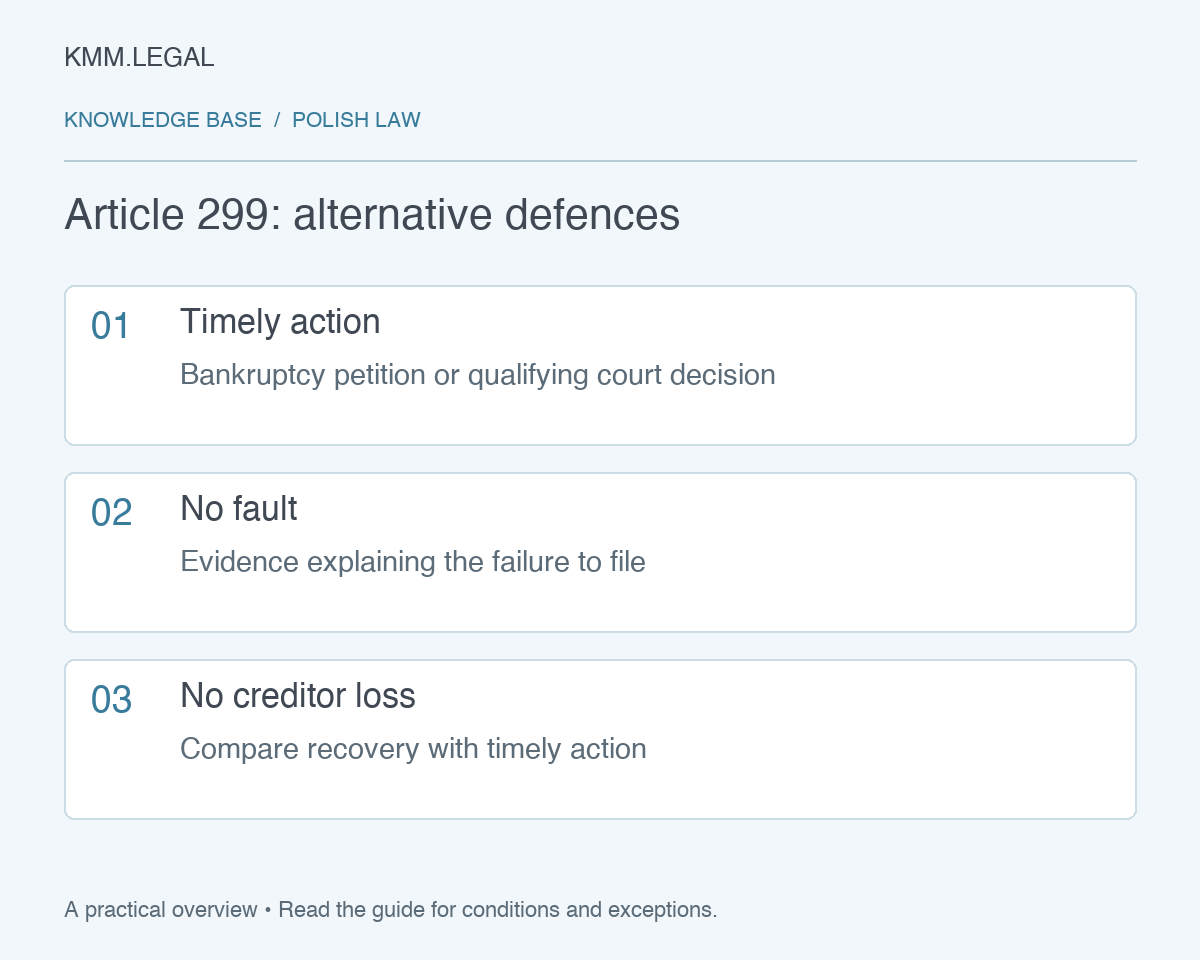
Defence 1: action at the proper time
A board member may show that a bankruptcy petition was filed at the proper time. Alternatively, within that time a court must have issued a decision opening restructuring proceedings or approving an arrangement in arrangement approval proceedings.
The distinction is important: filing a restructuring application, signing with a supervisor or publishing a PZU notice is not the same as obtaining the court decision specified in Article 299(2). The PZU timetable must be coordinated with the company’s bankruptcy obligations.
Defence 2: no fault in the failure to file
The board member can demonstrate that the failure to file a bankruptcy petition was not their fault. This requires facts and evidence explaining why the obligation could not be performed.
An internal division of responsibilities, outsourcing accounting or expecting a rescue investor does not automatically establish absence of fault. Preserve requests for financial information, reports received, board correspondence and the actions taken in response. Living abroad does not itself resolve the statutory test.
Defence 3: the creditor suffered no loss
A further defence is that the creditor suffered no loss despite the absence of the timely action specified by the statute. This normally requires comparing actual recovery with the position that would have followed a timely response.
Reconstruct the assets, secured claims, costs and distribution priorities at the relevant date. The company having no assets today does not prove there was no loss earlier. Expert financial evidence may be needed. The three principal grounds are alternatives; a defendant does not have to establish all of them.
Insolvency and the 30-day filing period
Article 11 of the Bankruptcy Law addresses inability to perform due monetary obligations. Delay exceeding three months creates a statutory presumption; it is not a guaranteed waiting period. Legal persons may also meet the separate over-indebtedness test, subject to the statutory conditions and exclusions.
Article 21 generally provides 30 days from the occurrence of the grounds for bankruptcy to file the petition. Identify the trigger from contemporaneous financial evidence rather than waiting for litigation, a tax demand or the outcome of investment talks.
Other objections and preparation for a claim
Article 299(4) contains a special exclusion connected with enforcement through compulsory administration or sale of the enterprise when the filing duty arose during that enforcement. The Constitutional Tribunal judgment of 12 April 2023, P 5/19, also matters where the proceedings establishing the company’s debt began after the defendant ceased to be a board member: the former member must be able to raise the non-existence of that debt within the scope of the ruling.
- Document appointment, resignation or removal and the relevant dates.
- Collect the claim, judgment, enforcement materials and service records.
- Reconstruct cash flow, aged debts, assets and decisions during the period of distress.
- Locate filed petitions, proof of filing and court decisions.
- Check the response deadline, limitation issues and the evidence needed for each defence.
Tax arrears require a separate analysis under Article 116 of the Tax Ordinance. The defences are not identical.
Discuss your plans with KMM.LEGAL
We review the documents, explain the Polish legal framework and agree the scope of advice or representation in English.
Legal sources and scope
Checked on 14 October 2026. This guide explains Polish law in English; the linked Polish legislation is authoritative. Earlier proceedings may be subject to transitional provisions. The application of these rules depends on the facts and documents of each matter.