
Knowledge Base / Restructuring
Debt recovery in Poland: restructuring and bankruptcy
Recovering a debt from a Polish company? Learn how to protect your claim in restructuring or bankruptcy, meet KRZ deadlines and obtain legal support.

An unpaid invoice from a Polish customer requires a different strategy once the customer enters restructuring or bankruptcy. The priority is to identify the proceedings, protect your claim and meet the relevant deadlines. Repeated payment demands or a judgment obtained abroad do not replace participation in the Polish collective procedure.
This guide is for overseas suppliers, lenders and other business creditors. It explains the main routes to recovering a debt from a Polish company in financial distress and how KMM.LEGAL can support creditors in Poland.
Your Polish customer has not paid: what should you check first?
Confirm the debtor’s exact legal identity, including its KRS number where applicable. A trading name or brand may be used by a different entity from the company that signed the contract. Check the National Register of Debtors (KRZ) for restructuring and bankruptcy notices and inspect the relevant orders and case reference. Also identify who currently represents the business: its management, a supervisor or an administrator.
Distinguish a filed application from an order opening proceedings, and a PZU notice from a court opening order. These events have different effects. If no collective procedure applies, ordinary collection, litigation or enforcement may remain appropriate, subject to jurisdiction, limitation and the contractual terms. A bankruptcy petition should not be treated as a routine substitute for resolving a genuinely disputed invoice.
- Collect the contract, purchase orders, invoices and proof of delivery or performance.
- Separate the principal, interest and other charges, and identify the currency and due dates.
- Check admissions of debt, complaints, payments, credit notes and any counterclaims.
- Identify security, guarantees, credit insurance and retention-of-title clauses.
- Record every notice and deadline; do not wait for the debtor to explain the procedure.
Debt recovery in Poland: restructuring versus bankruptcy
| Issue | Restructuring | Bankruptcy |
|---|---|---|
| Main route | Verification of the claim, negotiations and an arrangement with creditors | Lodging and establishing the claim, followed by distributions from the estate |
| First procedural step | Check the procedure, relevant date, creditor list and arrangement coverage | Check the bankruptcy order and claim-lodging deadline |
| Individual enforcement | Restrictions depend on the procedure, protection period and claim | Enforcement against estate assets is generally replaced by the collective process |
| Recovery | May involve instalments, deferral, reduction or other arrangement measures | Depends on assets realised, costs, security and statutory ranking |
| Creditor action | Review proposals, exercise voting rights and challenge defects where permitted | Monitor the list, object where necessary and review distributions |
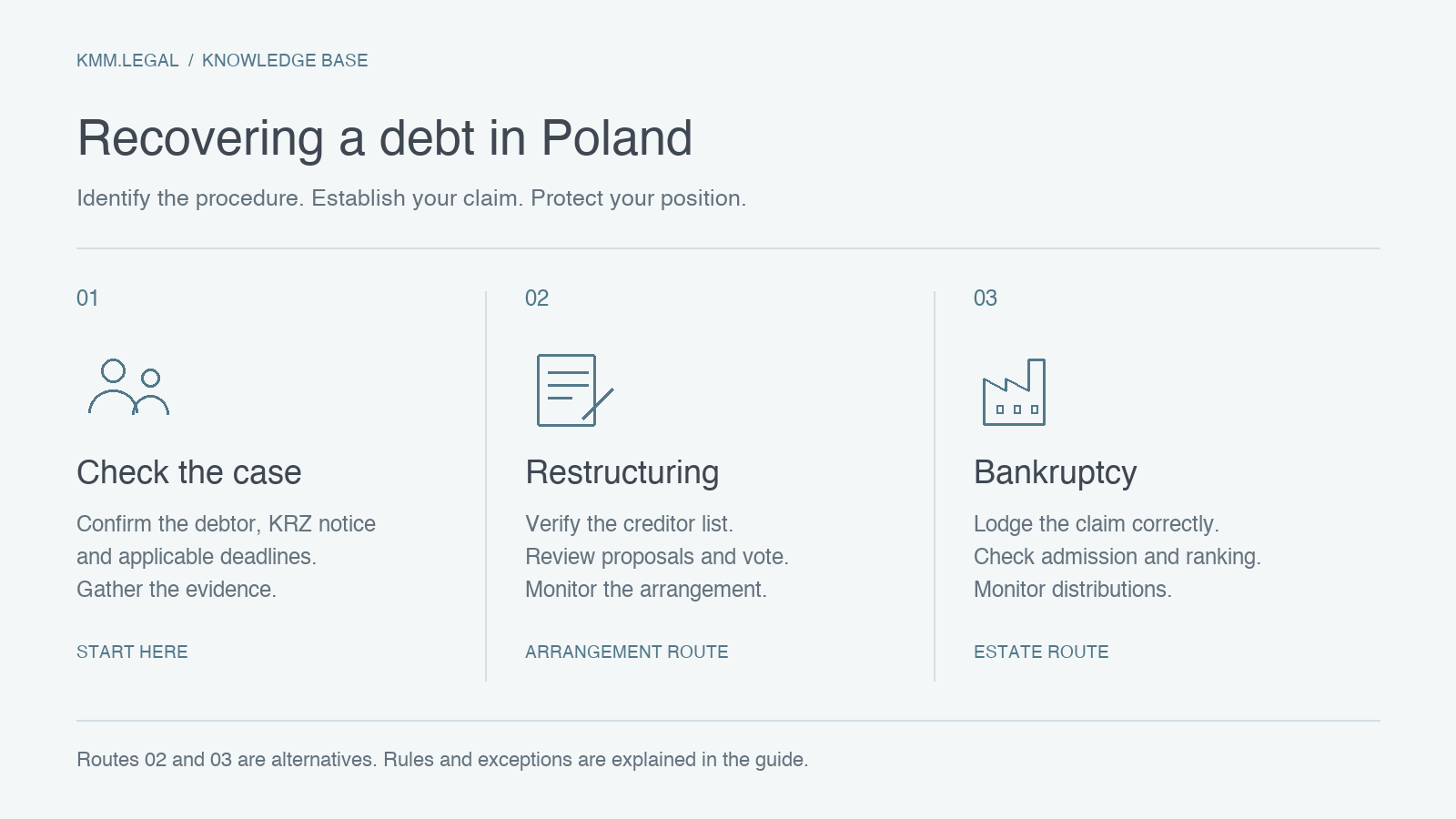
How do you recover a debt in Polish restructuring proceedings?
Poland has four restructuring procedures. Their level of court involvement and the powers of the supervisor or administrator differ. Our guide to types of restructuring proceedings in Poland explains the framework. Before acting, check which procedure applies and whether it is governed by current rules or transitional provisions.
Check whether the arrangement covers your claim
As a starting point, personal claims arising before the opening of restructuring are covered, subject to statutory exceptions. PZU uses an arrangement date under its own rules. An invoice’s payment deadline alone does not determine when the underlying claim arose. Continuing contracts and supplies spanning the relevant date need particular care (Articles 150–152 and 211 of the Restructuring Law).
Under the current framework, security over the debtor’s assets does not by itself mean a claim is outside the arrangement. Review the security value, creditor grouping and the proposed treatment. Older proceedings may be subject to different rules. Do not assume that a secured creditor can simply disregard the procedure.
Make sure the creditor list is correct
Restructuring does not use the same general claim-lodging mechanism as bankruptcy. The supervisor or administrator prepares the creditor list using the debtor’s records and other evidence. Send the supporting documents, check the amount and treatment recorded, and act if the claim is omitted, disputed or wrongly classified.
The remedy depends on the procedure. In arrangement proceedings and sanation, Article 91 generally provides a two-week objection period running from the relevant notice about the creditor list. Accelerated arrangement proceedings and PZU have different mechanisms; that objection route must not be assumed to apply universally.
Assess the arrangement before voting
Compare the proposed payment schedule and any reduction with the business plan, funding, security and expected alternative recovery. Request the available information supporting the proposals and the statutory creditor comparison. Check your voting amount, group and authority to sign. A vote should reflect an assessment of likely recovery, rather than only the headline percentage offered.
An approved arrangement can bind creditors who oppose it. Article 166 also deals with claims not entered in the list and an exception for creditors whom the debtor failed to disclose and who did not participate. Missing a vote is therefore not a reliable way to remain outside an arrangement. Objections and appeals have their own standing requirements and deadlines.
Check the stay and monitor performance
Restructuring may suspend or restrict individual enforcement. The scope depends on the procedure and applicable protection; for PZU, signing an agreement with a supervisor alone does not activate the protections associated with a KRZ notice. A payment demand, lawsuit and enforcement action are distinct steps and may be treated differently.
After approval, monitor instalments and continuing obligations. A missed payment may justify further action, but does not automatically cancel the arrangement. Review the statutory route for amendment or revocation and the options against other liable persons before acting.
How do you lodge a claim in Polish bankruptcy proceedings?
For an ordinary business creditor, the core step is generally a claim lodged with the bankruptcy trustee (syndyk) through the electronic system supporting the proceedings, normally KRZ. Sending an invoice to the debtor’s former management or an informal email to the trustee should not be treated as a valid procedural filing.
- Read the bankruptcy order and notice. Article 51(1)(4) provides a 30-day claim-lodging period from publication of the bankruptcy order in KRZ. Check the actual notice and any applicable cross-border rules.
- Prepare the claim and evidence. Identify the creditor and debtor, principal and ancillary amounts, supporting documents, ranking, security, relevant litigation and bank account details (Articles 236 and 240).
- File through the proper channel. Check representation, signatures and the filing confirmation. Statutory exceptions exist, including for specified employee claims and secured claims entered ex officio; an ordinary trade creditor should not assume an exception applies.
- Verify the trustee’s list. An objection to admission or refusal is generally subject to a two-week period from the relevant notice about the list, subject to standing and formal requirements (Article 256).
- Monitor distributions. Recognition of a claim establishes participation; it does not promise payment in full or by a fixed date.
Late filing can cost money and reduce practical recovery. Article 235 provides a statutory flat-rate cost based on 15% of the relevant previous-year third-quarter wage benchmark, subject to its exception. Under Article 252, a late claim does not change distribution plans already submitted and, once admitted, participates in subsequent plans. Prompt filing therefore matters even if the claim appears undisputed.
Under Article 146, enforcement begun before bankruptcy against estate assets is suspended on declaration and generally discontinued when that order becomes final. New individual enforcement against estate assets is generally prohibited, with statutory exceptions. A foreign judgment does not give an unsecured creditor an automatic right to bypass these rules.
What about security, guarantees and set-off?
Security may substantially affect recovery, but its legal validity, scope, priority and collateral value need review. In bankruptcy, the proceeds of encumbered assets are generally allocated under separate statutory rules, after relevant deductions (Articles 345–346). Ordinary unsecured claims are paid according to statutory ranking and the funds available; earlier categories and estate costs can materially affect the dividend.
A retention-of-title clause requires separate assessment of its effectiveness and whether the goods can be identified. It should not automatically be treated as an ordinary unsecured invoice or as an unconditional right to remove goods from the debtor’s premises.
Guarantees and third-party security may offer a parallel route. Article 167 of the Restructuring Law generally preserves rights against guarantors and co-debtors and specified security over third-party property. Check the instrument, applicable law, limitation and any separate proceedings affecting that third party.
Set-off has special insolvency restrictions. In bankruptcy, review Articles 93–96, including when the claims arose or were acquired and the requirement to declare set-off no later than lodging the claim. Do not rely solely on an accounting net balance.
Practical issues for foreign creditors
- Language and authority. Prepare company-register evidence, powers of attorney and translations where required. Do not assume English documents or email correspondence satisfy every Polish procedural requirement.
- Cross-border rules. Where Regulation (EU) 2015/848 applies, Articles 53–55 provide rules on foreign creditors’ participation, information and lodging claims, including a standard form. Check its application to the particular procedure and creditor; not every country or international case falls within the same regime.
- Currency. For the bankruptcy list, Article 251 provides conversion of foreign-currency claims using the relevant NBP rate at declaration, or the statutory alternative. Distributions are made in PLN. The original currency obligation is not thereby rewritten as a PLN debt.
- Continuing trade. Separate historic claims from new deliveries and obtain clarity on authority, payment terms and risk before extending further credit.
- Costs and prospects. Assess likely recoveries against representation, translations, procedural fees and monitoring costs. No fixed dividend or completion time follows from the amount of the invoice alone.
How KMM.LEGAL helps overseas creditors recover debts in Poland
We advise and represent creditors in Polish restructuring and bankruptcy proceedings. Our work can include checking the debtor’s procedural status, reviewing claims and security, preparing and lodging claims, verifying creditor lists, objections and other remedies, assessing arrangement proposals, negotiations, voting and monitoring performance or distributions. The engagement is tailored to the claim and the applicable procedure.
We also assess possible recovery from guarantors or other liable persons where there is a legal basis. If director liability is relevant, see our guide to Article 299 liability and available defences. A director is not automatically personally liable merely because a company has failed to pay.
Explore our restructuring and insolvency legal services or contact KMM.LEGAL about an unpaid Polish debt. For an initial review, prepare the debtor’s details, contract, invoices, proof of performance, security documents and any KRZ notices.
Our affiliated company BM Restrukturyzacje also performs statutory insolvency and restructuring functions. Those independent roles are distinct from acting as counsel for an individual creditor. We check conflicts before accepting an engagement.
Legal sources and scope
Checked on 15 October 2026. This guide concerns ordinary business claims in Polish corporate restructuring and bankruptcy. Special regimes, transitional provisions, the applicable contract law and international jurisdiction may change the analysis.
- Polish Restructuring Law, particularly Articles 76–97, 119, 150–167, 211, 226a–226g, 259, 278 and 312.
- Polish Bankruptcy Law, particularly Articles 51, 93–96, 144–146, 235–256 and 342–346.
- Regulation (EU) 2015/848 on insolvency proceedings, particularly Articles 53–55 where applicable.